I work in a pottery studio as a hobby. Every glaze test goes the same way: weigh the powders, mix, dip, fire, wait a day, open the kiln, and find out you were wrong. Sometimes the glaze runs off the pot. Sometimes it crazes a week later.
Glaze Lab is my attempt to move part of that guessing onto a screen.
How It Works
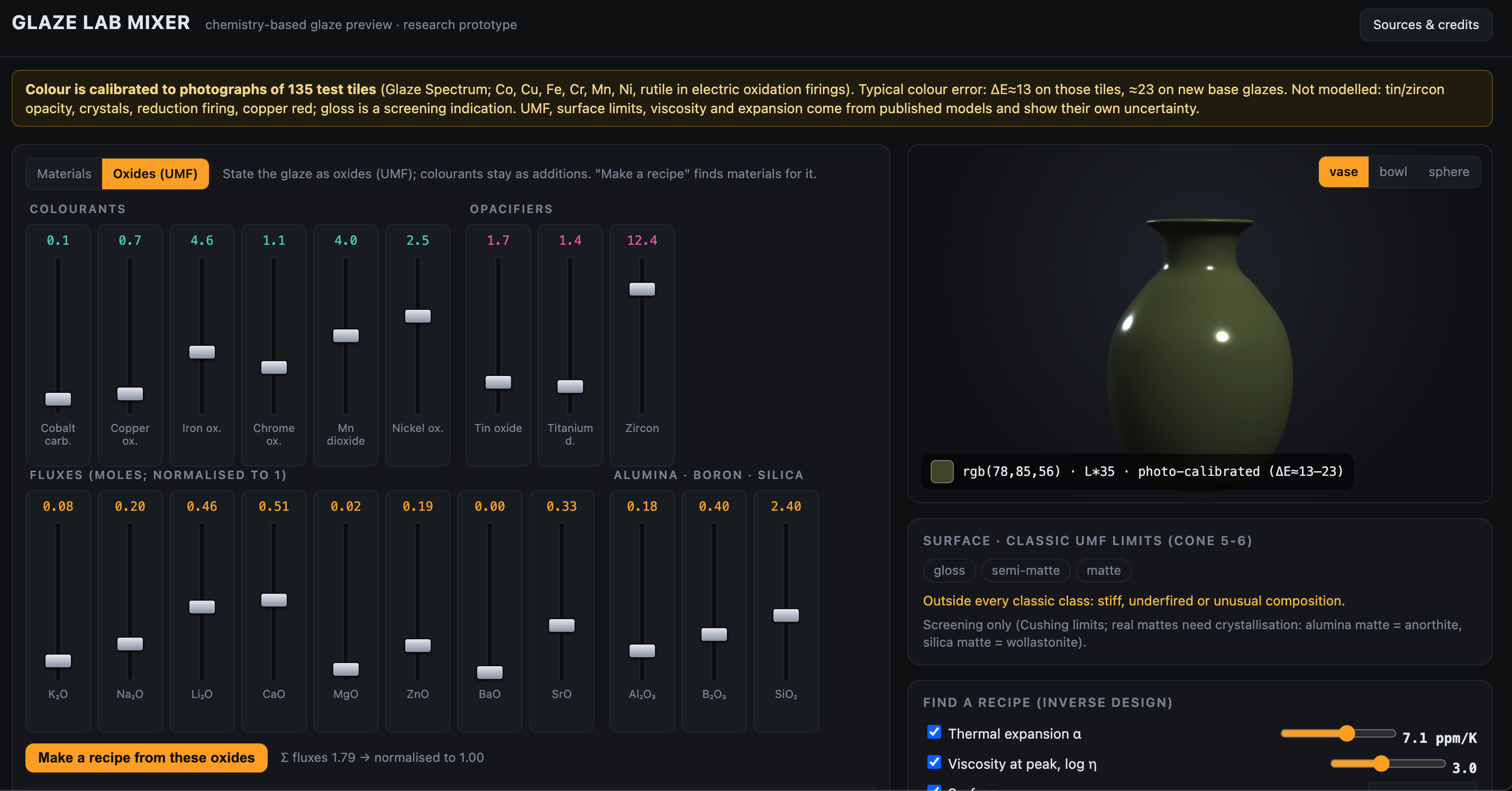
It looks like a mixing desk. Every fader is a material (feldspar, whiting, silica, kaolin, zinc oxide) or a colouring oxide. You choose a cone range and a layer thickness, and the glaze appears on a 3D vase, bowl or sphere. You can also switch to oxide mode and state the glaze as a Unity Molecular Formula instead, or enter your own material with the analysis from its data sheet.
Next to the preview you get the numbers: the UMF, the likely surface (gloss, semi-matte, matte), how runny the melt is at peak temperature, and its thermal expansion. If you type in the expansion of your clay body, it tells you how likely the glaze is to craze. And you can run it backwards: say what expansion and surface you want, and it searches for a recipe.
Where the Numbers Come From
The rule I set myself: no coefficient goes in without a published source. Viscosity and expansion come from [Alexander Fluegel's glass models](https://glassproperties.com/viscosity/). The oxide redox behaviour comes from [Duffy and Ingram's work on optical basicity](https://doi.org/10.1016/S1631-0748(02)01448-0). The surface limits come from the classic [Unity Molecular Formula research](https://ceramics.org/) of Carty, Katz and Gill. Colour uses [Kubelka-Munk theory](https://doi.org/10.1364/JOSA.38.000448), the same physics paint chemists use. The full list is at the end of this post and on the site.
I also checked the models against about 80,000 glass compositions from the [SciGlass database](https://github.com/epam/SciGlass). Fluegel's viscosity model was off by roughly 0.4 on a log scale for glaze-like glasses. The expansion model ran about 0.4 ppm/K too high on average. Those figures are shown next to the results instead of hidden behind a single confident number.
What It Can't Do
This is where it gets honest. The colour model was calibrated on photographs of 135 test tiles, and on a base glaze it has never seen it is typically off by a visible amount. Tin and zircon opacity, crystalline glazes, reduction firing and copper red are not modelled. A glaze that passes here still has to be fired, and nothing here says whether a glaze is food safe.
So it is a screening tool: it helps you decide which test tiles are worth making, not whether to skip them.
What I Learned
The most interesting part was how often the data disagrees with the confident version of the story. Models published as general are accurate only inside the compositions they were built on, and many glazes sit outside that. Showing that edge turned out to be more useful than a prettier preview.
Sources
- A. Fluegel, "Glass viscosity calculation based on a global statistical modelling approach", Glass Technology: European Journal of Glass Science and Technology A 48(1), 13-30 (2007). [glassproperties.com/viscosity](https://glassproperties.com/viscosity/)
- A. Fluegel, thermal expansion model and calculator, glassproperties.com (2007). [glassproperties.com/expansion](https://glassproperties.com/expansion/)
- A. Fluegel, "Statistical regression modelling of glass properties: a tutorial", Glass Technology A 50(1), 25-46 (2009). [glassproperties.com/principle](https://glassproperties.com/principle/)
- J. A. Duffy and M. D. Ingram, "Solvent properties of glass melts: resemblance to aqueous solutions", Comptes Rendus Chimie 5, 797-804 (2002). [doi:10.1016/S1631-0748(02)01448-0](https://doi.org/10.1016/S1631-0748(02)01448-0)
- P. A. Bingham, J. M. Parker, T. Searle, J. M. Williams and I. Smith, "Novel structural behaviour of iron in alkali-alkaline-earth-silica glasses", Comptes Rendus Chimie 5, 787-796 (2002). [doi:10.1016/S1631-0748(02)01444-3](https://doi.org/10.1016/S1631-0748(02)01444-3)
- W. M. Carty, M. Katz and J. Gill, "The Unity Molecular Formula approach to glaze development", Ceramic Engineering and Science Proceedings 21(2), 95-107 (2000). [ceramics.org](https://ceramics.org/)
- P. Kubelka, "New contributions to the optics of intensely light-scattering materials, Part I", Journal of the Optical Society of America 38, 448 (1948). [doi:10.1364/JOSA.38.000448](https://doi.org/10.1364/JOSA.38.000448)
- Z. Zhai, S. Li, J. Shao and J. Yu, "GlazyBench: a benchmark for ceramic glaze property prediction and image generation", arXiv:2605.06641 (2026, preprint). [arxiv.org/abs/2605.06641](https://arxiv.org/abs/2605.06641)
- SciGlass glass property database (text version by D. R. Cassar), used here to check the models. [github.com/epam/SciGlass](https://github.com/epam/SciGlass)
[Try Glaze Lab](https://spntn.com/glazelab/)